
As part of Kirkstall Art Trail’s accessibility commitment, clear access information is provided for visitors. These are known as visitor access guides.
Use this how to guide to complete the visitor access guide form.
About visitor access guides
A visitor access guide provides key information to help people plan their visit. It is an in-depth description of a place or space, describing the route to get in and what the facilities are like inside. Because visitors have diverse access needs, the guide helps them decide if a place is accessible for them.
Each access guide has a photo of the venue showing the entrance, with a link to the exact location on the what3words website. Next to the photo is a menu with at least five categories, covering the full address and in-depth accessibility detail. Some guides may include extra photos or directions on how to find the venue.
The access guides can be found at the bottom of every venue page. The 2026 Venue Directory links to these individual pages.
Guidance to filling in the access information document
The guidance helps you to write your descriptions and gives you prompts on what to look out for when doing so. It includes example visitor access guides.
Venue description
Approaching the building
Remember, keep the approach to the entrance clear by removing items like wheelie bins, rubbish bags, and plant pots.
- Is the path leading up to the venue level? (Level access means no step or threshold higher than 2 cm.)
- Is the ground even? Describe the surface, for example, stone paving, tarmac, or concrete.
- Is the ground uneven? Describe the surface, for example, cobbles, gravel, grass, mud, or cracked paving slabs.
- Are boards available to lay over loose gravel or soft mud, to create a firmer path, if needed?
- Is there a gate? Describe it, for example, whether it’s wooden or metal, its height and width, whether it’s heavy, and whether it will be unlocked.
- Is the entrance into the garden step-free? Describe any steps, for example, their height and depth, how many there are, and whether there are handrails.
- Can a ramp be provided?
Keep the approach to the entrance clear by removing items like wheelie bins, rubbish bags, and plant pots.
Entrances
Describe the entrance to the building.
- Is the entrance step-free?
- Is there an alternative accessible entrance?
- If there are steps, describe them, including the number of steps, their height and depth, and whether there are any handrails or grab rails.
- Will the door be unlocked? Do visitors need to knock to gain entry?
- Do the doors open automatically? What direction do the doors open?
- Are they heavy to push or pull?
- How wide are the doorways? Wheelchairs come in a range of styles and sizes. The minimum legal width for a doorway to be wheelchair accessible is 775 mm (30.5 inches); widths between 900–1000 mm (35–39 inches) are more ideal, as they’re easier for wheelchair users to pass through.
Private residences are not expected to have step-free entrances or wide doorways, but a description of the entrance is still needed. Note: handrails support movement along a run of steps or a ramp; a grab rail gives steadying support at a single step or threshold.
Interior
Describe the interior.
- Is there room for a wheelchair to manoeuvre (if applicable)?
- Describe the ground surface, for example, carpet, rugs, tiles, or floorboards.
- Does the visitor need to pass through any hallways or other rooms to reach the exhibition space? If so, describe the route.
- Are there chairs for visitors to sit on?
- Is there limited room for visitors? How many people can comfortably fit in the room? (optional)
Dogs
Assistance dog owners have important rights under the Equality Act 2010. Under this law fully trained assistance dogs have full rights of access to public places, spaces and services. This does not cover private residences, but we do encourage you to be as accessible as possible.
Assistance Dogs UK states the following:
“Assistance dogs are highly trained to carry out a range of tasks and alerts that support a disabled person or someone with a long-term medical condition. They are trained to behave well in public, and remain calm, attentive and close to their human partner. As a result of this training, assistance dogs are unlikely to jump up or bark, unless this forms part of an escalated alert, and they are very unlikely to display signs of fearfulness or aggression towards people or other dogs.”
When filling out this section, consider the following:
- Is your venue dog-friendly? Do you also allow pet dogs?
- Do you provide water bowls for assistance/guide dogs?
- Is there an outdoor area where all dogs can relieve themselves? Or is there a specific area designated for assistance dogs only?
- Are there bins for disposing of waste?
- Are there any other dogs or animals at your venue?
- Is there a limit to the total number of dogs allowed inside at any one time?
If pets other than dogs live at the venue, let us know so this can be included – some visitors may have allergies or a fear of animals.
Visitors are asked to keep their dogs on a lead at all venues, as a courtesy to other visitors and venue owners.
Toilets
Describe the toilet’s facilities.
- Are there public use toilets on the premises?
- Is there an accessible toilet? Are there support handrails beside the toilet (indicate if they’re on one side or both)? Is there room for a wheelchair to manoeuvre, and can a support assistant or companion fit inside?
- Is there a gender-inclusive toilet? Are there separate male and female toilets?
- Are there baby changing facilities?
There is no obligation to provide toilet access for a private residence.
Food and drink
- Is food or drink served? If so, what kind, for example, hot or cold beverages, meals, or dietary-specific options.
- Is it counter service only, or is table service available, or can it be requested, for example, for a visitor with a disability?
- Can highchairs be provided for babies and small children?
- Are large print or pictorial menus available?
- Do menus list ingredients, and can visitors make special dietary requests?
- Is this a breastfeeding-friendly space?
- Are there any unique circumstances, for example, pay as you can, or free of charge?
Private residences aren’t obliged to offer food or drink. Refreshment spots are listed on the Kirkstall Art Trail amenities page.
Photograph of venue
The venue listing includes a photograph to help visitors identify the location.
- The photo must show the path or street leading to the venue.
- The photo must also show the entrance to the venue.
- If possible, move any objects that are obstructing this view, such as cars.
- The photo must be clear and good quality, and in landscape orientation.
- Pick a bright, clear day to take the photo, if possible.
- Extra photos can be sent if they help describe the venue in more detail. For these additional shots, either landscape or portrait orientation is acceptable.
The example below shows the entrance to Hollybush Classroom.

Examples
These examples show what a completed visitor access guide looks like. Every year, all access guides are reviewed for each returning venue, to check for any changes.
Example for a public venue
Hollybush Conservation Centre, Broad Lane, Kirkstall, Leeds LS5 3BP
Venue type
Community – conservation centre
Split over several areas – the Barn, the Classroom, the Roundhouse, the shelter, and the garden.
Approach
- Hollybush is a two-minute walk from Kirkstall Bridge Shopping Park, across the Kirkstall Bridge.
- Do not use the wooden gate at the front of the building, facing the road.
- The main entrance is via the driveway.
- There are a small number of Blue Badge parking spaces.
- The driveway and car park are surfaced with tarmac.
- There is a clearly marked pathway painted in a contrasting colour to guide pedestrians.
- There is a wooden gate into Hollybush at the end of the driveway.
Inside Hollybush
- Access is step-free and wheelchair-accessible.
- The garden pathway consists of block paving and flagstones.
- The surface transitions to wood chip and packed earth towards the rear of the garden.
- Their facilities also include a bike shed – bring your own lock.
The garden is shown below.

If you become overwhelmed by the Art Trail, Hollybush has a dedicated quiet space where you can take some time out.
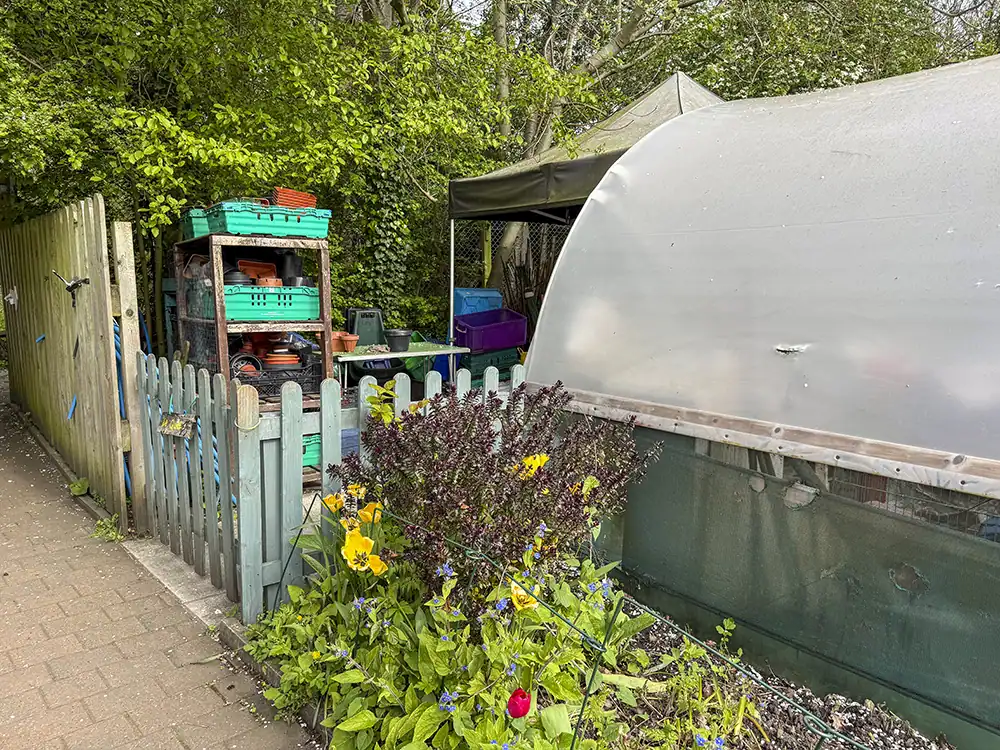
- The quiet space can be found in the garden.
- It is on the right-hand side as you walk past the Roundhouse and the polytunnels.
The entrance gate is shown below.
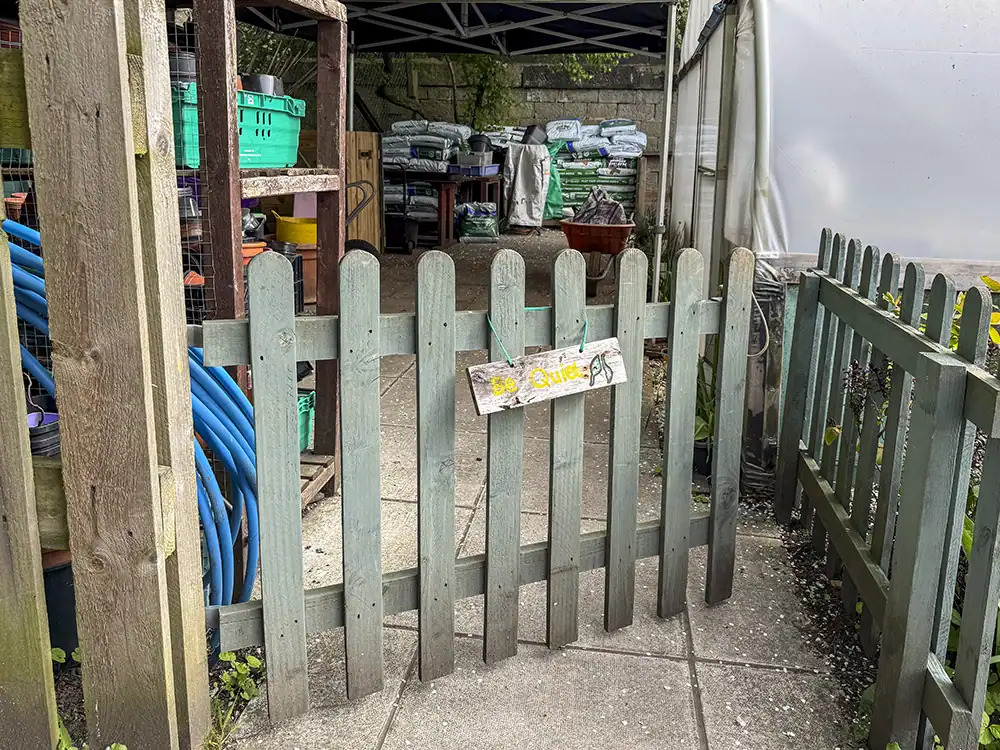
- You can also find quiet in the polytunnel next to the small yard.
- As it is a greenhouse, it can become uncomfortably hot on sunny days.
- There are entrances at either end of the polytunnel.
The polytunnel is shown below.

- Both assistance dogs and pet dogs are welcome but must be kept on a lead.
- Dog water bowls are available at the front entrance of the café.
The facilities include:
- separate male and female toilets in the café
- one gender-inclusive accessible toilet in the café
- three gender-inclusive accessible toilets in the toilet block
- baby changing
The toilet block is shown below.

- There is a café at Hollybush, located next to the Barn.
- The menu includes lunches, options for children, and a variety of baked goods.
- Vegan and gluten-free options are available.
- Hot and cold drinks are served, and milk alternatives are available.
- Counter service.
- The entrance is low and situated under a flight of stone steps.
- The door has a width of 90 cm and a height of 180 cm.
The café entrance is shown below.

The café is managed by Café 21, part of Sunshine and Smiles, the Leeds Down Syndrome Network. The café is run by and for people with Down’s syndrome, to provide training and work experience that leads to job opportunities.
Example for a private house
Norman View, Kirkstall, Leeds LS5 3JJ
Venue type
Private residence – back-to-back terraced house.
Approach
- The pavement has recently been resurfaced with tarmac and is on a steep hill.
- There is a metal gate into the garden, 115 cm high and wide, with the latch on the left-hand side.
- There is one step up into the garden, 7 cm high.
- There is a concrete path towards the house.
Entrance
- The front door will be unlocked, with the handle on the right-hand side, and opens inwards.
- There is a step up into a small porch, 20 cm high.
- There is a door sill that extends out by 7 cm, with the threshold 7 cm high and wide.
- There is a grab rail on the left-hand side of the exterior wall, and a metal gate on the right-hand side.
Interior
- There is an interior door that opens inwards, with a step up into the room, 20 cm high.
- There is a grab rail on the right-hand side.
- There is carpet on the floor, with a rug secured to avoid trip hazards.
- Seating is available.
- Both assistance dog and pets dogs are welcome but must be kept on a lead.
- A small friendly dog lives here.
- Check with the venue owner before entering.
- Only one dog is allowed at a time.
- A water bowl is available at the front door.
- There is a clearly labelled bin available for disposing of dog waste in the garden.
Not available at this venue.
Not available at this venue.
Appendix
These are descriptions that have been used across a variety of venues, to help in writing your own guide.
Venue description
Approach
- [Street name] is surfaced with [cobblestones/tarmac/paving].
- The public footpath is surfaced with [Yorkshire stone/tarmac/paving slabs].
- The pavement has dropped kerbs. The approach to the venue is on a [steep/gentle] hill.
- The pavement has recently been resurfaced with [tarmac/paving] and is on a [steep/gentle] slope.
- There is a [wooden/metal] gate into the garden, [height] cm high and [width] cm wide, with the latch on the [left-hand/right-hand] side.
- There is [number] step(s) up into the garden, [height] cm high and [depth] cm deep.
- The [path/garden/driveway] consists of [paving slabs/grass/soil/gravel]
- There is a [concrete/paved/grass/gravel/stone] path towards the house.
Entrance
- There is a step [into a porch], [height] cm high.
- There is a door sill that extends out by [depth] cm.
- The door threshold is [height] cm high and [width] cm wide.
- The door opens [inwards/outwards].
- There is a grab rail [at the step/threshold], on the [left-hand/right-hand] side.
- There are handrails on [both sides/the left-hand side/the right-hand side] of the [steps/ramp].
Interior
- There is a step [up/down] into the room, [height] cm high.
- The interior is on one level.
- The floor area is [carpeted/wooden floorboards/stone/tiled], with a rug [that has been secured to avoid trip hazards].
- There is a hallway leading to [where the exhibiting artists are].
- Visitors pass through the [room, for example, kitchen or living room] to reach [where the exhibiting artists are].
- There is a corridor connecting [rooms/areas] where the exhibiting artists are.
- There are [number] rooms visitors can access.
- Only the [room name, for example, ground floor / front room] is accessible to visitors.
- The room is [small/limited] in size; up to [number] visitors can comfortably fit at one time.
- Seating is available [numbers if known].
Multiple levels
- The venue is split across [number] areas.
- There are [number] stone steps leading down/up to [location], [height] cm high and [depth] cm deep, with [no] handrails [on both/left-hand/right-hand side(s)].
- There is a lift to the [floor]. The lift has a clear door width of [width] cm, with interior dimensions of [width] cm by [depth] cm.
- There is very little turning space on the [floor] for mobility scooters or wheelchairs.
Dogs
- Both assistance dogs and pet dogs are welcome but must be kept on a lead.
- Assistance dogs only.
- Not at this venue.
- Dog water bowls are available.
- There are bins available for disposing of dog waste.
- There is an outdoor area where all dogs can relieve themselves.
- There is a designated area for assistance dogs only to relieve themselves.
- A friendly dog lives here.
- A small friendly dog lives here; they are nervous around other dogs.
- A quiet and friendly dog lives here, medium to large in size.
- A cat lives here.
Toilets
- Not available at this venue.
- The toilets are [location, for example, downstairs, in the café, or upstairs].
- Separate male and female toilets.
- Gender-inclusive accessible toilet.
- Facilities in the accessible toilets include [list].
- Baby changing facilities are available in [location].
Food and drink
- Not available at this venue.
- Food and drink is available in [location, for example, the café, the garden, or the front room].
- They serve [cold/hot/alcoholic/soft drinks, cold/hot food, sandwiches/snacks/cakes].
- Special diets [gluten/vegetarian/vegan] are available.
- Counter service only.
- Table service available.
- Table service can be requested.
- Highchairs are available.
- [tea/cake] will be available.
- A small donation towards [organisation] is welcomed.